

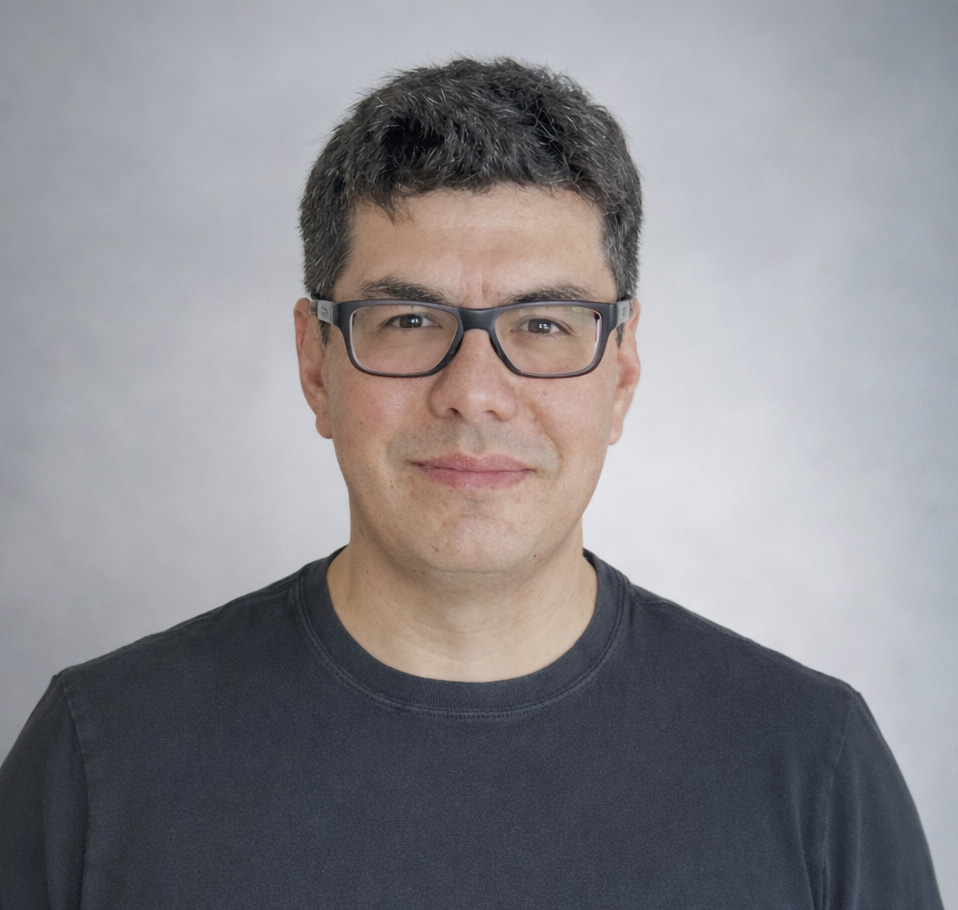
 Pedro A. Ramos-Goycolea explores how MC USA’s Hope for the Future gathering reveals a faith rooted in abundance, solidarity and Spirit-led leadership among BIPOC communities.
Pedro A. Ramos-Goycolea serves as pastor of Shalom Mennonite Fellowship in Tucson, Arizona, where he helps nurture a multicultural and multilingual community rooted in peace, justice and belonging.
As a newly called pastor at Shalom Mennonite Fellowship in Tucson, almost everything feels new.
I’m settling into new rhythms of ministry, less scripted seasons, shared leadership and communal discernment, and my own spiritual life is being reshaped along the way. As I revisit the path that formed my faith, I find myself drawn to the Anabaptist vision as a lived counter-witness: a commitment to nonviolence, a reimagined understanding of power and a way of following Jesus with the Sermon on the Mount at the center of everyday life. In many ways, those values gently but clearly push back against empire itself, and that emphasis on nonviolence, shared life and embodied obedience resonates deeply with what I’ve long loved in Latin American liberation theology: a faith that refuses abstraction and insists on solidarity.
And yet, amid all this newness, one experience felt surprisingly familiar.
This year, I was invited to participate in Hope for the Future, a gathering of BIPOC leaders within Mennonite Church USA. It was my first time attending.
From the moment I arrived, I felt welcomed, but not in a way that required explanation. The welcome was implicit. Of course, the logistics were stated clearly: where the bathrooms were, when the breaks would happen. But the deeper practices of the gathering did not need to be announced. Space was made for every voice. Listening was generous. People spoke with confidence, without apologizing for taking up space. Laughter sprang easily, and when tenderness opened the door to tears, it happened naturally, without embarrassment; it felt empowering.
No one needed to declare the space “safe.” Our bodies already knew.
It was the kind of understanding that grows out of shared experience, of living as a minority within larger systems, of carrying stories marked by both marginalization and resilience. There was an ease in the room that came from recognition, from seeing big pieces of your own story reflected in someone else’s face.
Throughout the event, I kept searching for a word to describe what I was experiencing.
The word that finally rang in my ear was abundance.
There was an abundance of gifts in that room. Abundance of theological insight. Abundance of cultural wisdom. Abundance of lived experience in justice work. Each leader carried a particular lens for reading Scripture and a particular story of navigating church systems.
But the greatest abundance was embodied by the host congregation, Iglesia Cristiana Roca de Refugio, San Antonio, Texas.
Food, in many of our cultures, is more than sustenance. It is memory. It is resistance. It is belonging. The tables were constantly replenished. There was always more than enough.
That might be true for any church gathering in any cultural context, though. But Roca de Refugio is a congregation made up largely of families in the asylum process, people living between statuses, navigating unjust immigration policies and carrying the weight of systemic oppression. Some have known detention. All know uncertainty.
And yet, they extended hospitality with overwhelming generosity.
Their welcome was not naïve about suffering. It was not disconnected from struggle. It was resisting the scarcity with which they were treated the moment they arrived seeking refuge in this country. Their hope is founded on the kind of faith that multiplies loaves and fishes, because where others see a few loaves, others see more than enough. Their abundance was not about excess. It was about trust.
I wonder if that’s the reason why this gathering is called Hope for the Future.
Because if the church can learn to stand in solidarity with communities in their most vulnerable places, not as saviors, but as siblings, then there is hope. If leadership can emerge from those who know displacement, racialization and resilience firsthand, then the future of the church may be more faithful than its past.
And then, there was my humbling moment.
During a small-group activity, I leaned forward and asked the person in front of me, “And you are?”
He replied kindly, “I’m Glen. I serve as executive director of MC USA.”
In that instant, I realized I was clearly the new kid on the block, the only person in the room who didn’t recognize him.
It was embarrassing for a second. And then it was freeing.
Because what struck me afterward was this: in that space, titles did not carry more weight than testimony. Leadership felt relational, not hierarchical. We were not gathered around position, but around calling.
In that space, titles did not carry more weight than testimony. Leadership felt relational, not hierarchical. We were not gathered around position, but around calling.
As a new pastor in this tradition, I left Hope for the Future feeling inspired, energized and hopeful.
Abundance is not something we manufacture. It is something we recognize when we trust that the Spirit is already at work among us, especially in communities the world calls the margins but, in God’s Kin-dom, are the center.
As I continue learning the rhythms as pastor of Shalom Mennonite, I am grateful to belong to a church wrestling toward justice and peace. The future of the church will not be secured by strategy alone, but by communities that embody welcome, solidarity and practiced hope.
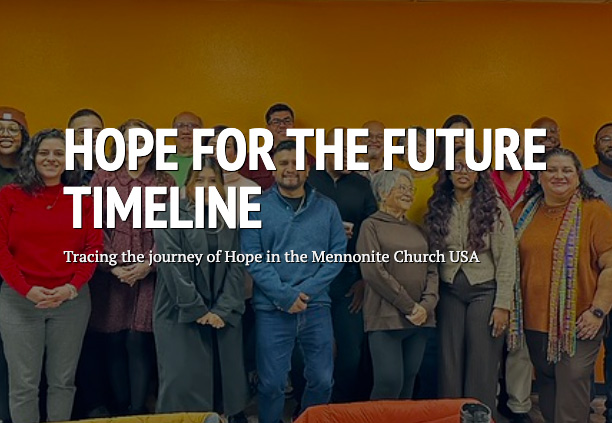
Trace the journey of hope by visiting MC USA’s Hope for the Future timeline.