


ELKHART, Indiana (Mennonite Church USA) — Mennonite Church USA is celebrating its peace witness by honoring Weldon Nisly and Fernando Daza-Jabian as its 2026 Bring the Peace award recipients. Now in its sixth year, the Bring the Peace award honors individuals who embody Christ-centered peacemaking in their communities and beyond.
“Weldon and Fernando reflect our Anabaptist calling to follow Jesus in the way of peace,” said Lorraine Stutzman Amstutz, MC USA’s director of Peace & Justice. “They both have demonstrated their tireless and consistent efforts to create pathways of peace, reminding us all that the work of peacebuilding is a calling and a daily practice.”
Sponsored by the Church Peace Tax Fund, the Bring the Peace award recognizes two individuals: a Legacy Peacemaker, who has demonstrated a lifelong commitment to peace and justice, and a Young Peacemaker, who is beginning to make a meaningful impact through courageous witness and compassionate action. Each recipient receives a $300 grant.
Legacy Peacemaker: Weldon Nisly
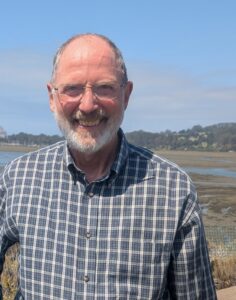
Photo credit: Hope Nisly
Weldon Nisly’s warm smile and friendly pastoral voice belie the fiercely committed peacemaker who, after four decades of pastoral and peace ministry in the church, “retired” from congregational ministry to devote time to international peacebuilding. At a time when others his age might be seeking to slow down, Nisly has served with Community Peacemaker Teams, mostly on the CPT Iraqi Kurdistan and Palestine teams for the past decade.
Raised in rural Iowa, Nisly first learned about peace as a child from his grandfather, a conservative Mennonite bishop. His interest in politics led him to study political science in college and become a political organizer. Later, Nisly earned a degree in Peace Studies at Anabaptist Mennonite Biblical Seminary, Elkhart, Indiana. He then moved to Philadelphia, Pennsylvania, with his wife and two young children to join an intentional community and serve in peace ministry under Mennonite Central Committee.
Nisly said he never intended to be a pastor, but living in community awakened his pastoral calling. Within a couple of years, three urban Mennonite churches approached him about being their pastor, prompting him to “listen to what God is telling me.” Two years later, Cincinnati (Ohio) Mennonite Fellowship called Weldon to be their pastor, where he served from 1984-95. He was then called as lead pastor by Seattle (Oregon) Mennonite Church, where he served from 1995-2013. Peacemaking was central to both congregations.
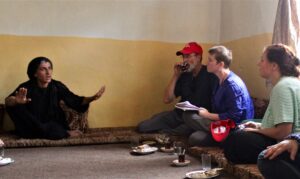
Aklima, a Kurdish farmer from the village of Dupre in the Kurdistan Region of Iraq, speaking to the CPT Iraqi Kurdistan team and delegation about Turkey’s bombardment in their region under the guise of the War on Terror. Drinking tea and listening to stories of people targeted by war is a primary way CPT provides accompaniment and documents the consequences of war. Nisly is second from left. CPT Iraqi Kurdistan team photo used with permission.
“I loved pastoral ministry,” Nisly said. “I would not change a day of it in either congregation. Yet, in a profound way, pastoral ministry prepared me to do the best work of my life in peacemaking.”
In his 70s, he joined CPT to help fulfill its mission for “building partnerships to transform violence and oppression.” This meant accompanying people targeted by war, advocating with them for their human rights and amplifying their voices at home and around the world.
“Most importantly, we practice presence – by sitting on the floor, drinking tea and listening to the people living in the shadow of war,” he explained.
Nisly frequently amplifies their voices by giving CPT presentations in churches across North America. He wants Christians here to understand how their support for war or silence harmfully impacts communities half a world away.
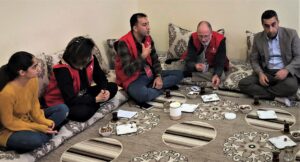
Sleman Mousa (right), Kurdish headmaster who had been imprisoned by the Kurdish Regional Government and falsely accused of plotting to overthrow the KRG. The CPT Iraqi Kurdistan team accompanied him and his family through his imprisonment, trial and release. The CPT IK team visited Sleman Mousa and his family in their home when he was released. Photo left to right: Sleman Mousa’s daughter, Runak and Kamaran (Kurdish CPT IK team members), Nisly, Sleman Mousa. CPT Iraqi Kurdistan team photo used with permission.
“Nonviolent accompaniment and advocacy mean showing up, being present and refusing to be silent,” he said.
Nisly’s life is an encouragement to others to step beyond comfort and stand alongside those most impacted by violence. His advice to those who seek to “bring the peace,” however, is simple and applicable to everyday decisions. Referencing Deuteronomy 30, Nisly said: “Peace is more who we are than what we do. Every choice we make in life — small and large — is a choice for life or death. Support for war and silence are both complicit in the systems of death. Therefore, choose life, as God created and calls us to be and do.”
Now in his 80s, Nisly hopes to slow down – but not yet. He continues to serve with CPT, which is in its 40th year of peacebuilding, as the co-chair of the CPT Steering Committee. CPT is in a season of transition, and Nisly is giving primary attention to hiring its new executive director. Later, he looks forward to relinquishing CPT leadership roles to devote more time to writing and speaking about the people, places and encounters that have shaped his peacemaking journey.
Young Peacemaker: Fernando Daza-Jabian

Photo credit: Meaghan Godzisz
“In his calm and confident manner, Fernando walks directly into situations where well-thought-out reason is needed, and, at the same time, he can walk away from situations that are unhealthy. These are signs of a young peacemaker behind his years … Fernando is well deserving of this award,” wrote Gilberto Perez, Jr., vice president for Student Life and Hispanic Serving Initiatives and dean of students at Goshen (Indiana) College, on MC USA’s Bring the Peace nomination form.
This spring, Fernando Daza-Jabian, who attends Waterford Mennonite Church in Goshen, earned his bachelor’s degree in business, with a double major in Peace, Justice and Conflict Studies, from Goshen College. As a student, he served in leadership roles on campus with the Prevention Intervention Network, the Latino Student Union, the Academic Response Team and as a peer financial coach through Everence on campus. Daza-Jabian is currently serving as an administrative intern with Business Continuity Planning at Indiana University Health in Indianapolis, Indiana.
“All throughout Fernando’s college experience at Goshen College, he has sought to bring people together to address issues such as immigration and conflict,” wrote Perez.
“I am passionate about creating spaces where people feel empowered, supported and able to advocate for themselves and their communities,” said Daza-Jabian. “Much of my work has focused on violence prevention, financial empowerment and creating opportunities for marginalized communities to thrive.”
For several years, he has volunteered with the Center for Healing & Hope in Goshen, serving in the Natural Helpers Program. The program facilitates connections between immigrants and community volunteers who speak their language, bridging the gap to essential resources such as food, transportation, housing, jobs, language classes, legal assistance and more.
“I am especially proud of organizing and leading a financial wellness workshop in Spanish for community members at the Center for Healing and Hope,” said Daza-Jabian, who is multi-lingual. “Seeing people engage with the material and leave feeling more confident reminded me that peace and justice can also mean creating the conditions for people and communities to thrive.”
He reminds other peacemakers that peacemaking doesn’t require a title, a certain personality or years of experience.
“Peacemaking begins when you find something you care deeply about and have the courage to take one small step toward making it better,” said Daza-Jabian.
About the Bring the Peace awards
The Bring the Peace awards reflect MC USA’s Renewed Commitments to follow Jesus, witness to God’s peace and experience the transformation of the Holy Spirit. Rooted in Anabaptist faith values, the initiative calls individuals and congregations to nurture empathy, compassion and love while actively seeking to dismantle oppression and violence.
Each year, MC USA Peace and Justice department welcomes Bring the Peace award nominations from across the denomination. A selection committee comprised of previous Bring the Peace award recipients reviews submissions and selects the honorees.
The awards are sponsored by MC USA’s Church Peace Tax Fund, an MC USA initiative that reinforces the denomination’s role as a historic peace church by invigorating the collective voice against the destructive powers of militarism in our congregations, communities and beyond. The fund supports educational programs that address militarism and promote ways of living peacefully:
- The Bring the Peace recognition program, which honors a Legacy Peacemaker and a Young Peacemaker each year.
- Grants for war tax resisters.
- Peaceful Options for Training and Careers (POTC), an independent initiative formed by MC USA and Mennonite Central Committee that helps young adults find non-military career, service and training opportunities.
Support MC USA’s peace building work here. Gifts may be designated to the Church Peace Tax Fund or POTC. Checks can also be mailed to Mennonite Church USA, 718 N. Main Street, Newton, KS 67114, noting “EB Peace & Justice” in the memo line.
Mennonite Church USA is an Anabaptist Christian denomination, founded in 2002 by the merger of the Mennonite Church and the General Conference Mennonite Church. Members of this historic peace church seek to follow Jesus by rejecting violence and resisting injustice. MC USA’s Renewed Commitments state the following shared commitments among its diverse body of believers: to follow Jesus, witness to God’s peace and experience the transformation of the Holy Spirit. Mennoniteusa.org
Written by Camille Dager.