

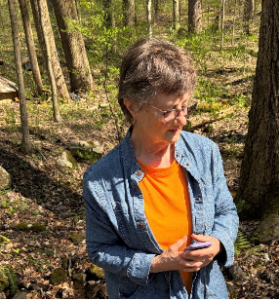
 This Thanksgiving, Leslie James invites readers to cultivate gratitude by noticing the wonder of God’s Creation and discovering how the natural world reveals God’s love, care and provision.
Leslie James is retired and can usually be found in her garden or studio. She is involved in worship planning and visual arts at Hope Mennonite Church, Wichita, Kansas, where she is a member.
This Menno Snapshots blog is part of a series by the Mennonite Spiritual Directors Network.
I suspect many of us were raised to believe that only humankind truly mattered, that being concerned about Creation was a grave distraction from the true mission of the church. It was certainly my experience in the fundamentalist church in which I grew up. That never felt right to me. The sense of disconnect continued to grow within me through my working years as changes in climate and growing seasons continued to become more pronounced. Upon retiring, I decided to take a deep dive into Scripture to learn more about God’s relationship with God’s Creation.
What I discovered – in Genesis 1, the Psalms, the prophets, the first chapter of John, Jesus’ teachings, Paul’s letters and the final chapters of Revelation – was God’s undeniable love, care and concern for all of Creation.
I discovered we have long confused, or conflated, the responsibility and stewardship of dominion in Genesis 1:26 with domination. Genesis 2:15 tells us that humankind was put in the Garden to till and keep it. The Hebrew word “shamar,” translated as keep, is the same word used in the blessing of Numbers 6:24: “the Lord bless and keep you. We have seized upon the Great Commission of Matthew 28 yet ignored that same commission as recorded by Mark: “Go into all the world and proclaim the gospel to the whole creation”. Romans 8 speaks of the groaning for the restoration of all creation, and the closing verses of Revelation give us a glimpse, not somewhere beyond the blue, but of God’s Creation made whole, fully restored.
I’m still learning, still studying, but the evidence of God’s love, care and concern for God’s Creation seems overwhelming in Scripture. Have we just become too removed from Creation in our modern world? Are we not listening to what early Anabaptist, Hans Hut, called “the gospel of all Creation”?
My path into wonder and awe, conversation and relationship, with God through God’s Creation has been in the garden. It’s there that I learn about interdependence, community, God’s depth of care and provision – the ways in which Jesus’ teachings in the Sermon on the Mount are not only illustrated, but demonstrated, in the relationships between plants, soil, wildlife, weather and seasons. My time in the garden is often a holy time. Words are not spoken, yet conversation and relationship take place – perhaps a glimpse of God coming to walk with Adam and Eve in the cool of the day, as we read in Genesis 3:8, or what poet Mary Oliver calls “prayers made of grass” in her poem, “Mindful.”
Others may find their entry through birding, rocks, stars, clouds, wildlife, seasons, the structure of soil or the truly exquisite designs found throughout Creation. There is no end to the wonder and awe in Creation, and no end to the depth of relationship to be discovered in Creation. Mary Oliver’s poem, “Instructions for Living a Life,” is a concise, yet profound, three-lines long. “Pay attention. Be amazed. Tell about it.”
Perhaps we’ve overcomplicated things and made them too cerebral, thus missing out entirely on Anabaptist Hut’s “gospel of all Creation.” What if, as Jesus instructed in Matthew 18:3, we change and become like children? Children out in creation are open to noticing, discovering, getting close, being amazed and telling about it. Children go out into Creation with excitement and anticipation, ready for whatever might catch their eye or engage their curiosity and imaginations. They go ready to be amazed. Jesus tells us to be like children.
What if we were to start greeting one another by telling each other what astonished us since last we met? Or asking one another how we’ve been amazed by Creation this week? What if we were to normalize telling about what has caught our eye and caused us to think more deeply? What if “pay attention, be amazed, tell about it” is how we learn to read God’s “Gospel of Creation” alongside the words recorded in Scripture?