

 Nathan Luitjens reflects on MC USA’s annual Conference Ministers’ Retreat and how MC USA leaders are re-centering their work around God’s dream of shalom, reconciliation and faithful presence in local contexts.
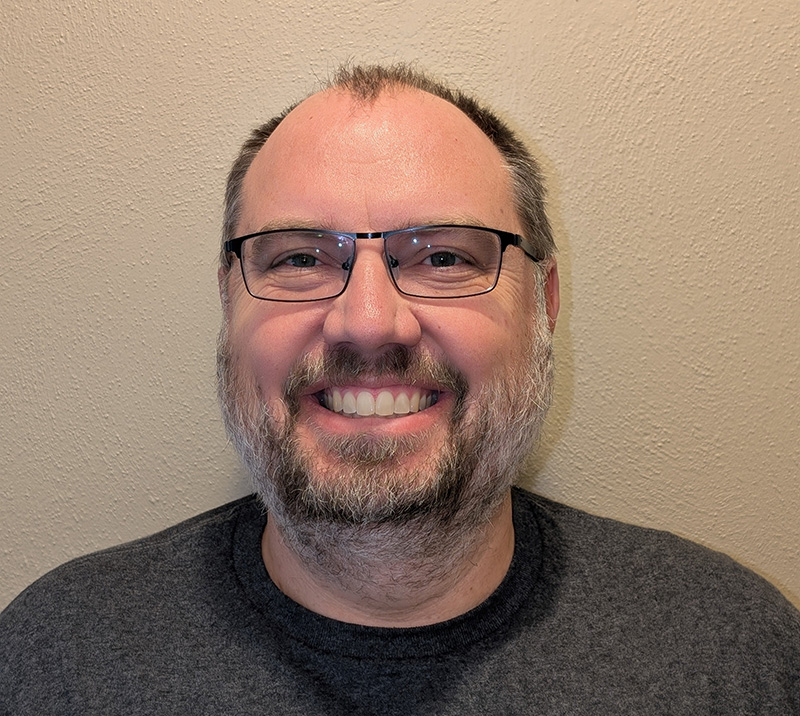
Nathan Luitjens is the executive conference minister for Central Plains Mennonite Conference. He and Rachelle are the parents of three young adults. When he is not engaged in church work, Nathan can often be found behind the bench in a hockey arena or on the touchline of a soccer field coaching youth sports.
On Dec, 3-5, 2025, conference ministers from across Mennonite Church USA gathered in Austin, Texas, to reconnect, fellowship, laugh and think about what is next for the denomination and our conferences. Michael Danner, MC USA’s associate executive director of Church Vitality, noted that this year’s gathering was a bit of an experiment, as we had Tim Soerens, executive director, and Juli Kalbaugh, director of operations, from Parish Collective join us to provide input and facilitate a discussion on the future of the church.
Soerens and Kalbaugh challenged us to begin to see the world differently. They began with three concentric circles. The largest circle represented the biggest question we need to ask ourselves, which is, “Why?” Why do we, in the church, do what we do? Why do we even exist? They posited that, for too long now, the church has thought that “building the church” is the reason for the church’s existence. We may call this various things, “building the kingdom,” or “creating a community,” among other things, but our underlying motivation for being the church is the church itself.
But what if we understood the “why” differently? What if instead of thinking we are called to build the church, we instead understand that we are being invited to live into God’s big dream for the world? As Mennonites, if we are to define God’s dream for the world, I think we would say that it is seeing God’s “shalom” spread everywhere. To say this differently, we might call this the reconciliation of all things. Or to use less churchy language, we might say the healing of all relationships – with withGod, with one another and with the very world in which we live.
Once we come to a common understanding of God’s dream for the world, then we can begin to ask questions, such as, “What is God inviting us to do?” and “How is God inviting us to do it?” If we, as Anabaptist/Mennonite Christians, see ourselves as people who are called to follow the nonviolent Jesus, then this will impact and define what we do and how we do it. I do believe we have a somewhat unique perspective on what it means to follow Jesus, one that our world needs to experience from us in all of the ways we interact with the world around us.
Finally, we find ourselves engaging with the questions of who and where. The question of who is important because it is here that the church is the answer to the question. The church exists for the sake of the world. It is not a social club, and it is not a place to hunker down and wait out the storm. It is the people whom God has called into being and has invited to be part of God’s dream for the world. The final question that we thought about with Soerens and Kalbaugh is the where” The folks at Parish Collective have chosen this name deliberately, because they want congregations to begin thinking about their local contexts – the places where they live, work, play, shop, etc. It is in these places that God is calling us to notice what is happening and what God is doing. It is in the everyday moments of our lives that we are invited to see and respond, following the nonviolent Jesus and bearing witness to God’s dream.
It is amazing to see the way this vision is shared by conference ministers from across MC USA. We all know that the way forward is not clear, but we believe that God continues to invite us to be part God’s incredible dream for the world.