
Explore the legacy of conscientious objection through one Mennonite family’s story and discover how Christians are reimagining faithful responses to war at the Waging Peace militarism summit.
Devon Miller is the archives coordinator for the Mennonite Church USA Archives. Miller holds a Bachelor of Arts in Bible and Ministry from Bethel University, Mishawaka, Indiana, a Master of Arts in Peace Studies from Anabaptist Mennonite Biblical Seminary, Elkhart, Indiana, and a Ph.D. in Cultural Anthropology with an emphasis on ethnohistory from Michigan State University, East Lansing, Michigan. He attends Florence Church of the Brethren Mennonite, Constantine, Michigan, in Central District Conference.
This Menno Snapshots blog is part of a series highlighting MC USA’s Waging Peace, A Militarism Summit, Nov. 6-7, Leola, Pennsylvania.
As I have been planning a display for MC USA’s Waging Peace: A Militarism Summit, I have been struck by the wide range of responses Mennonites have had to war over the years. Some paid taxes for the right to abstain. Some paid to have a substitute serve in their place. Some chose to endure prison sentences rather than serve in the military. Some served in alternative roles rather than in the armed forces. Some men chose to serve in the military in various capacities. Still others, especially women, chose to serve in humanitarian roles, even when they were not obligated to enlist. But what strikes me most is that these decisions were not based on singular motivations. Rather, they emerged at the intersection of conviction and experience.
During World War II, many Mennonites, Amish and Brethren chose to serve in Civilian Public Service (CPS). They were classified as IV-E (later called 1-W) because they objected to all military service – combatant and noncombatant. The complexity of these decisions is clearly displayed in a collection of letters that my father, Ezra J Miller, wrote while serving in the CPS program from 1942 to 1946. In the last days of my mother’s life, she told us of the stash of letters that my father had written during his CPS experience in World War II. I expected to find six, at most 10, letters tucked away in the drawer she described. Instead, we were delighted to discover more than 70 letters he had written to various family members during his time in CPS.
Before my father passed in 1992, he often shared fascinating stories about his CPS experience. What we discovered in the letters he left behind, however, surpassed even his captivating storytelling. The letters bear witness to a young man’s struggle to make sense of the world into which he had been flung.
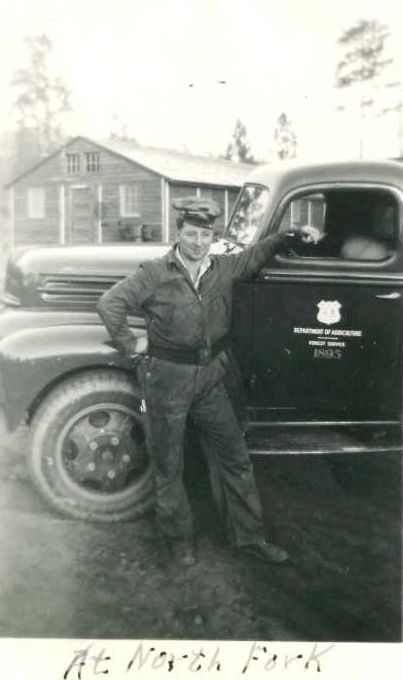
Ezra Miller serving in CPS in North Fork, Calif.
The first indication of the struggles my father faced came from external pressures. My father entered CPS on February 22, 1942, as a 24-year-old single man who grew up in the Old Oder Amish church in Arthur, Illinois. Six weeks into his time at Camp #22 in Henry, Illinois, he wrote to his brother, “The [conscientious objectors] sure have a better reputation around them [than] what they had when this camp first started” (Ezra J Miller to Peter J Miller, March 31, 1942). The change in reputation came after men from Camp #22 were called upon to assist in the recovery of a devastating tornado that had ripped through the local community.
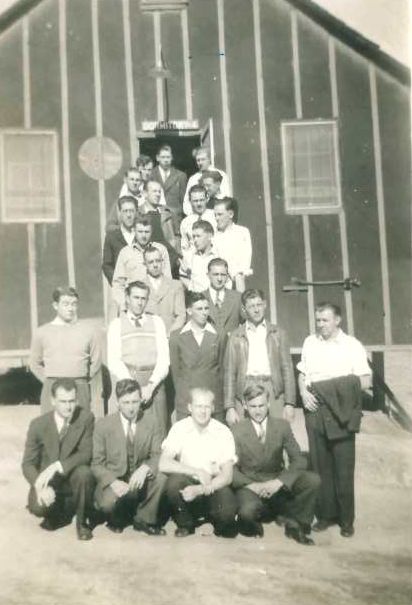
Ezra Miller with his dorm mates in North Fork, Calif. Ezra is in the front row, second from left.
At other times, the struggles came from within the camps themselves. After my father was transferred from Henry, Illinois, to Camp #35 in North Fork, California, he wrote again to his brother that some of the men were tired of their directors’ “stunt[s]” and that “[t]here are some that I hear that are going to try and get out of here and go IAO [Class I-A-0, or Conscientious Objector available for noncombatant military service]” (Ezra J Miller to Peter J Miller, December 7, 1942). Serving in the military, even in a noncombatant role, was a significant theological and moral step.
In early March 1943, my father was transferred to Camp #79, Provo, Utah. In May, he had an appendicitis attack and required emergency surgery. The surgery went well, but afterward, he developed a blood clot that lodged in his lung. He endured severe pain and almost died. In his letters, he expressed deep appreciation for the expert care he received from the resident doctor during his ordeal.
In the following months, there are indications that he struggled with his work as a CPSer. In November of 1943, he wrote to his brother, without giving much context, “I believe I could get out too if I’d join the Army,” but then went on to say, “but I don’t think that’s just quite the way to go about it” (Ezra J Miller to Peter J Miller, November 3, 1943). At that point, he seemingly changed the subject and discussed a sore foot that had been bothering him.
It is not until January of 1944 that he elaborated on his struggles. Again, writing to his brother, he expressed a desire to visit home to discuss the matter in person. In this letter, he wrote, “I know, or I think I know that you won’t like this idea, but I am thinking seriously of signing up for I-A-O. The reason I tried so hard to get a release on account of my foot was that I wouldn’t have to make up my mind what I will do, but I won’t get an exam as long as I’m here and can do this work OK” (Ezra J Miller to Peter J Miller, January 27, 1944).
At first, it seems that my father was looking for an excuse to leave his assignment. But reading on, he explains the source of the conflict within. He writes,
“When I first came to when I was so sick last summer the first clear thoughts that I had were that I’d like to be in or should be in the medical corps where I could maybe give some boys help that are suffering as bad or maybe worse then (sic) I was that one day. The only thing I can remember of that one day is the terrible pain I was in and of the Drs + boys when they’d give me a Hypo or sleeping pills and give me relief for a few hours. Well I made up my mind that as soon as I’m able to I’d sign up, but when the time came I decided to try and get a release and I’d never have to tell anyone this” (Jan. 27, 1944).
In the end, he decided to remain at Camp #79 without much explanation of how he arrived at that decision, except for a brief allusion in a letter about a month later: “I was very glad for your letter. I’ve often wished you would write more like it.” He never again mentions his desire to sign up as an I-A-O. From that point on, he firmly embraced his CO status, even his “nonresistant” convictions, but it was not without struggles — pressures from without and pressures from within.
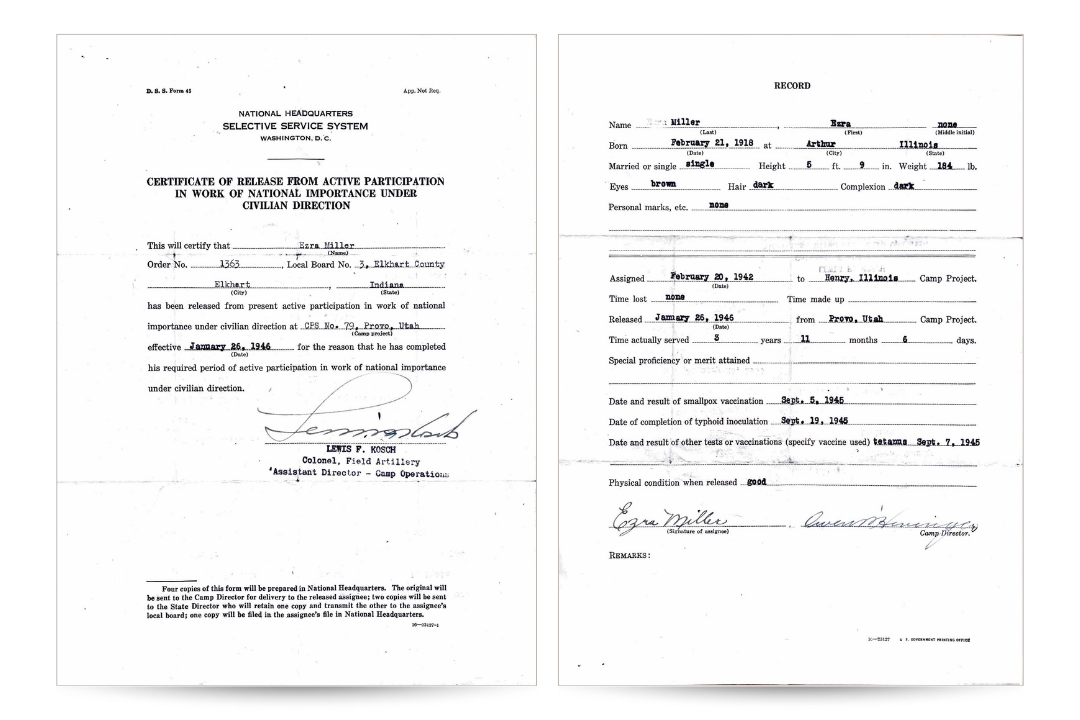
Ezra Miller’s release papers, documenting his 3 years, 11 months and 6 days in CPS.
My father’s story is just one of many that invite us to reflect more deeply on what it means to follow Jesus in times of war — a conversation we hope to continue at Waging Peace: A Militarism Summit, Nov. 6-7, Leola, Pennsylvania. The MC USA Archives display at the summit will feature a collection representing various eras of war and the complex circumstances Mennonites encountered as they discerned how to respond. The display will also include a list honoring Mennonites who served in various capacities during wars throughout American history. Our hope is that the display will encourage young people to see themselves within this rich history of faithful responses to war and to share with their friends and family the struggles they encounter as they discern how to live faithfully under a nationalistic government.