
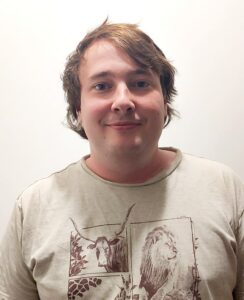
Photo by Lisa Stoltzfus.
Caleb Stoltzfus (he/they) graduated from Eastern Mennonite University in winter 2024 with a bachelor’s degree in History, with a minor in Political Science. He interned at Mennonite Central Committee’s Washington, D.C office and worked at Friendship Community as a direct support professional for the past six years. Stoltzfus attends Blossom Hill Mennonite Church, Lancaster, Pennsylvania.
This Menno Snapshots blog is part of a series highlighting MC USA’s Waging Peace: A Militarism Summit, Nov. 6-7, Leola, Pennsylvania. Stoltzfus will be leading a seminar, “Conscientious Objection & LGBTQ+ Witness,” with Jim S. Amstutz (he/him), peacebuilder and retired MC USA pastor and educator.
My grandfather, Glenn Martin, was a conscientious objector during the Vietnam War from 1964-1966. He did his 1-W alternative service in Indianapolis, Indiana, at a Goodwill store. He originally was a truck driver for Goodwill, but they moved him to administrative work when they learned he had bookkeeping experience. His stories were the first I heard about being a conscientious objector. I also grew up around people with pacifist values. I have been in the Mennonite church my whole life. I had a Mennonite education for high school and college. I deeply believe in pacifism. I believe that there is so much death that happens in the world every day, and I do not want to do anything to add to that. I believe that Jesus teaches us to love not to hate. Jesus told us to turn the other cheek. When he said that, he was telling us to participate in civil disobedience.1 I believe that is what being a conscientious objector is all about.
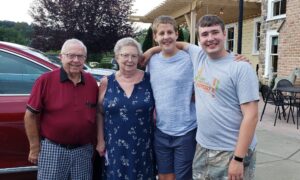
Caleb Stoltzfus (far right) with his grandparents and brother. His grandfather, Glenn Martin (far left), was a conscientious objector during the Vietnam War.
I still remember sitting in Bible class in high school, listening to our teacher, Jim Amstutz, talk about the option of becoming a conscientious objector. While listening to him, I just kept thinking about my grandfather – about the pressure that he must have been under to go to Vietnam and how brave he was to not go. I believe it is a brave thing to become a conscientious objector, especially when society is pressuring you to go to war and because people will say that you are “unpatriotic” if you are not willing to die for your country. Being a conscientious objector means deciding to follow the teachings of Jesus and, to quote Robert Frost, “take the road less traveled.”
In some ways, conscientious objectors and the LGBTQ+ community face similar challenges. It can be hard to push against society and forge your own path. The way I see it, that is what members of the LGBTQ+ community do and that is what conscientious objectors do.
I came out to my mom the summer after my first year of college. It was terrifying. I was 99% sure that she would support me, but that 1% was so scary. She of course loved and supported me, but it took so much courage to tell her. Being a member of the LGBTQ+ community is not easy in Lancaster County, Pennsylvania, or in the Mennonite church. Thankfully, I have been blessed to be embraced by the church and, for the most part, by my community. It is important to remember all the harm that Mennonites and Christians have done to the LGBTQ+ community. For so long, we have been on the outside of religion looking in. To a certain extent, so have conscientious objectors. That is why I think it is important to look at these two communities together and see how they intertwine.
1 As theologian Walter Wink points out, hitting someone on the right cheek was normally done with the back of one’s right hand from a person in power to a subordinate. By turning your cheek, you were saying, “At least treat me as an equal,” since striking someone on the left cheek would require an open palm. (Wink, Engaging the Powers, 176)
Did you enjoy this blog? Subscribe to PeaceMail for the latest news, blogs, events and resources from MC USA in one biweekly email.