
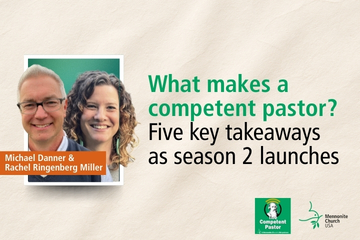
 Michael Danner and Rachel Ringenberg Miller, hosts of MC USA’s “The Competent Pastor” podcast, reflect on five key lessons from Season 1, as they launch Season 2 for pastors and congregational leaders.
Michael Danner is associate executive director for Church Vitality in Mennonite Church USA, supporting area conferences, congregations and pastors in their ministry. Prior to serving in this role, Michael served as conference minister for Illinois Mennonite Conference. He also has 20 years of experience as a local church pastor, serving 18 of those years as pastor of Metamora (Illinois) Mennonite Church.
Rachel Ringenberg Miller serves as denominational minister for Ministerial Leadership for MC USA. She focuses on engaging conferences and congregations, providing resources and services to meet the diverse demands facing congregations today. Prior to this role, she served as associate pastor for Portland (Oregon) Mennonite Church and as pastor of Shalom Mennonite Church in Newton, Kansas.
As we prepare to launch season 2 of “The Competent Pastor” podcast, we thought we would start by reflecting on what we learned through season 1.
We host this podcast as part of MC USA’s Church Vitality ministry. The podcast is an open interview format that starts with one question: What is the most important skill of a competent pastor? If you’re new here, get up to speed by bingeing the first six episodes from Season 1 on Spotify or Apple podcasts.
What have we learned?
Effective pastors are humble. Almost to a person, our season 1 pastors started their interviews with some form of, “I’m not sure I’m competent, but this is what I think…”
Pastoring is complex. This requires pastors to be competent at a wide variety of leadership tasks and relationship skills. Think Swiss Army knife, not single purpose tool. Pastors will not be excellent in all areas, but they must be competent in key areas: communication, organizational leadership, teaching/equipping, pastoral care and interpersonal relating.
The pastor as a person matters. Living into the calling of a pastor requires the pastor to be healthy, well-balanced emotionally and grounded spiritually. What the pastor carries with them in the role will impact how they function in that role. The healthier the pastor, the more likely the congregation is to be healthy as well. This makes understanding and maintaining healthy boundaries essential for long-term vitality in the pastoral role.
Pastors are pastoral contextual theologians. Competent pastors connect the Bible to everyday life. Before delivering the sermon, a pastor spends time reading the Bible, praying and contemplating the needs of the congregation and the community. Pastors care deeply about preaching well, as it is one of the primary ways they communicate with a congregation. They understand that preaching is not performance; it is an event that the Spirit can use for transformation.
Listening emerged as the “most important skill for a competent pastor.” This skill was expressed in many different ways, but the underlying ideas were rooted in deep listening. Pastors need to know the people in the community to lead well. Deep listening is rooted in care for the people and wanting what is best for them and for the community.
Season 2 starts with:
- Jon Carlson, lead pastor, Forest Hills (Pennsylvania) Mennonite Church
- Tory Bonners, Sojourners Mennonite Fellowship, Belfast, New York
- Randall Spaulding, First Mennonite Church Denver (Colorado)
- Hugh Hollowell, Open Door Mennonite Church, Jackson, Mississippi
If you are a pastor, give the podcast a listen! We’ll be releasing new episodes monthly, starting today!